

Carless in Vancouver, Part 2: Going for the high-hanging fruit
This is Part 2 of my trip last week to Vancouver, B.C. to meet up and exchange ideas with some of the leading thinkers in sustainable urban design and planning. (Carless in Vancouver, Part 1: Boots on the Ground described the first two days commuting between my Mount Pleasant neighborhood digs and the convention center to attend presentations about leading practices in resilient urban systems by ecocity pioneer Richard Register and sustainable developer John Knott.)
Specifically, I was there to discuss the International Ecocity Framework and Standards (IEFS), an initiative currently being developed by Ecocity Builders and an international committee of expert advisers that seeks to provide an innovative vision for an ecologically-restorative human civilization as well as a practical methodology for assessing and guiding progress towards the goal. As the UN is beginning to recognize the important role of cities and local governments in sustainable development — reflected in the Rio+20 Earth summit draft agenda — the need arises for transparent, verifiable and measurable indicators to track progress as cities and citizens move towards increased balance with living systems.
I know, that’s quite a mouthful. Measuring something as complex as entire urban systems can be quite the noggin buster, so let me just say, I feel your pain!

And let me also say this up front: When you’re looking to fundamentally change the unsustainable fossil-fueled structures upon which modern life hinges (rather than just tinkering around the edges with a little “Green” here and there), you not only run into much doubt and fierce resistance (including doubting yourself from time to time), but the harsh reality of how deep a hole we’ve dug for ourselves. For example, the City of Vancouver, often touted as one of the greenest cities in the world, has an environmental footprint of almost four times the sustainable level, meaning if everyone on earth lived as Vancouverites do today, we would need three to four planets to support that level of consumption.

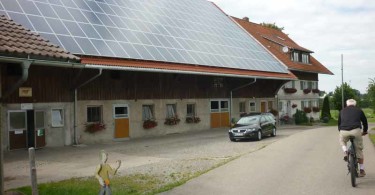
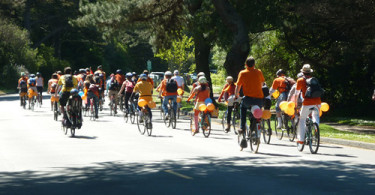
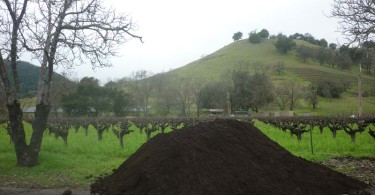
As I was roaming through Vancouver on the lookout for ecocity indicators, the reality of this footprint was reflected in many places. Despite Vancouver’s many successes in sustainable urban planning…

it quickly became apparent how far this metropolis still is from being an ecologically healthy city.

I was blessed to be able to spend time with some of the local visionaries who’ve been instrumental over the last 30-40 years in getting some of the EcoDensity principles implemented in developments that are today celebrated and held up as Vancouver’s finest. A common chorus was that none of it would have happened without the passionate activism and unflinching determination by a small group of visionary citizens who saw what was possible and insisted on making it happen, despite what most city officials and the planning establishment thought of the idea.

It is thus that I continue my journey through Vancouver with the full awareness that ecocities in their full manifestation currently do not yet exist anywhere on planet Earth, but, that without a clear vision of the multidimensional changes needed and a determination to work towards those changes our best intentions will do nothing more than put a green veneer on a structurally flawed foundation.
People say we should develop models that go for the low-hanging fruit. I say, let’s go for the high-hanging fruit. Leave the low-hanging fruit for the children.
- Richard Register
Ecocity Builders founder Richard Register celebrating the Jane Jacobs-inspired South Falls Creek Village in Vancouver.
Carless in Vancouver, Part 1: Boots on the Ground
A few of days ago I arrived in Vancouver, B.C. for a week of urban planning and playing. On the official schedule are presentations about leading practices in resilient urban systems, a workshop to assess the City of Vancouver’s rating in the International Ecocity Framework and Standards (IEFS) initiative, a brainstorming session to redesign the campus of the BCIT’s School of Construction and the Environment into an ecocity fractal, and a weekend retreat of the IEFS Core Advisory Committee discussing the IEFS on the road to Rio.
That’s quite a brainful of lofty concepts…

so let’s bring this down home…

As the venerable Danish architect Jan Gehl, author of Cities for People, points out:
A good city is like a good party – people stay much longer than really necessary because they are enjoying themselves.
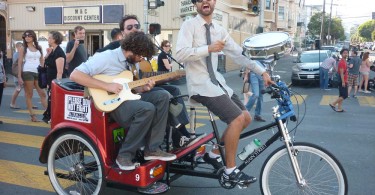
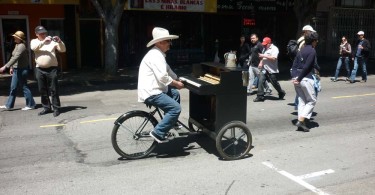
So let’s take a ride into Vancouver and see what there is to discover…

The Start of a Revolution
January 3, 2012: California becomes the sixth state to adopt law that allows the formation of corporations whose main purpose isn’t to make money.
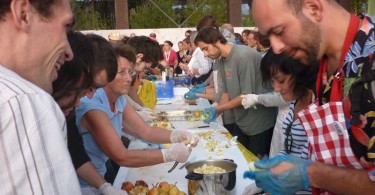
A day at the Secretary of State’s office in Sacramento, where California’s first twelve businesses filed to operate as benefit corporations.

California Vietnam Veterans Memorial in Sacramento’s Capitol Park, only a short walk from the Secretary of State’s Corporate Filing Office, honoring Brien Thomas (B.T.) Collins, Vietnam War veteran and CA Assembly Member, who “never wavered in the belief that one should give something back to society.”
I hope five or ten years from now we’ll look back on this day and say “this was the start of a revolution, because the existing paradigm isn’t working anymore. This is the future.”
- Yvon Chouinard, Founder of Patagonia, California’s first benefit corporation.
Photos by Debra Baida
Story by Sven Eberlein
How to start your own renewable energy company…
This month’s issue of Resurgence Magazine features The Reluctant Rebels, an article I wrote based on my visit last summer with 2011 Goldman Environmental Prize Winner Ursula Sladek in the small town of Schönau in the Black Forest region of Germany. It’s quite a remarkable story of a small community taking matters into their own hands, and you can read the whole piece here, but if there’s one moment in their journey that not only goes to the root of many of the ecological problems the planet and its inhabitants face but offers a textbook example of what motivates a determined activist, it’s this one:
As it turned out, the Schönau energy rebels would need all that energy in overcoming their next, more formidable obstacle. “We went to KWR, the power company that was operating the local grid, and asked them whether they’d like to join our conservation efforts,” Ursula recalls. “We just wanted to add a few energy-saving measures, like rates based on consumption, and incentives for more cogeneration units, but they said, ‘Conserve energy? Have you lost your mind? We want to sell energy, not save it!’”
Here’s the Goldman Prize video in which Ursula describes the transformation from a group of concerned parents into a non-profit energy cooperative that provides power from over 1,800 solar, hydroelectric, wind, biomass and cogeneration facilities to 115,000 homes and businesses throughout the country:
Also, Ode Magazine ran an article last month based on my visit with Peter Hasenbrink, pastor of the Schönau Lutheran church that became a legend when it covered its church roof in solar panels, calling them “Creation Windows” that provide “heavenly energy.”
I’ll be writing more about Schönau and its cast of energy rebels in the coming months, but for now some visual impressions of this giant little town from my trip this summer…
Occupying the Future: Benefit Corporations now opening shop in NY, six other states
At midnight last night, New York became the 7th state to pass into law legislation that allows the formation of a new and different type of corporation, one that is required to create benefit for society as well as shareholders: The Benefit Corporation. I heard about this from my friend Barb, whose husband’s company will apply immediately to be one of NY’s first benefit corporations.

What is a benefit corporation?
Benefit Corporations are a new class of corporation that
1) creates a material positive impact on society and the environment
2) expands fiduciary duty to require consideration of non-financial interests when making decisions
3) reports on its overall social and environmental performance using recognized third party standards.
Benefit corporation momentum has slowly been building for years, with legislation passed in California, Hawaii, Virginia, Maryland, Vermont, New Jersey, and now New York, and pending in North Carolina, Pennsylvania, Michigan, and Washington, D.C..
I have to admit that I didn’t know about these new entities until last week, when Deb told me that there was a call for a huge turnout on January 3rd at California Secretary of State Debra Bowen‘s office at 1500 11th Street in Sacramento, when companies in our state can start filing articles of incorporation under the Benefit Corporation designation, or existing companies can begin the process of transferring to a Benefit Corporation. (AB 361)
I’m thrilled to report that the seats were filled last week at the San Francisco Bay Area Green Chamber of Commerce’s sponsored presentation “How to Become a Benefit Corporation.” The enthusiasm in the room was palpable as Donald Simon, one of the three Bay Area attorneys who led this effort and co-wrote AB 361, walked attendees through some much amazing detail about this bill. Simon proudly pointed out that this is a piece of legislation that is written in English and not legalese!
I was thinking to myself, “wouldn’t this be a nice occasion for the Occupy movement to celebrate and cheer on the corporations lining up to change their status that day?”

HOT STUFF! From Durban to Rio – Introducing International Ecocity Framework & Standards
After largely ignoring the role of cities and local governments at its first 15 climate conferences, the United Nations Framework Convention on Climate Change (UNFCCC) took a huge step at COP16 in Cancun when the Subsidiary Body for Implementation (SBI) for the first time in history officially adopted local governments as “governmental stakeholders”. What this means in plain English is that the work being done in cities, towns, villages and communities around the world to lower our carbon footprint will from now on have a direct impact on the highest levels of decision and policy making in the UNFCCC.
Sounds somewhat trivial, unsexy and anticlima(c)tic, but a quick look at the UN’s own Global Report on Human Settlements 2011 – Cities and Climate Change as summarized by BBC news (UN report: Cities ignore climate change at their peril) shows why this was such a significant breakthrough:

- Urban areas are set to become the battleground in the global effort to curb climate change, the UN has warned.
- The assessment by UN-Habitat said that the world’s cities were responsible for about 70% of emissions, yet only occupied 2% of the planet’s land cover.
- While cities were energy intensive, the study also said that effective urban planning could deliver huge savings.
- The authors warned of a “deadly collision between climate change and urbanisation” if no action was taken.
The conversation about a Local Government Climate Roadmap process continues this Friday through Sunday at COP17 in Durban with the Durban Local Government Convention: adapting to a changing climate – towards COP17/ CMP7 to build on the outcomes of the Resilient Cities 2011 congress, which focused on “understanding and improving the profile of adaptation as a critical tool in achieving local developmental and sustainability objectives.”
What this means is that there’s going to be more talk about the role of cities at COP17, though it’s not exactly the kind of stuff that gets bodies moving and booties shaking.
But I betcha this will…
———————||
———————||
———————||
———————√


what there is